


Judaism in the polar regions? You bet! While there isn’t a synagogue at the North Pole (yet!), there has been, and there still is, a Jewish presence not far from the Arctic and Antarctic Circles. Read on for 12 facts about Judaism in the coldest parts of our planet.
1. “White Nights” in the Russian Capital
The city of Petersburg (known as Leningrad under Soviet rule), once Russia’s capital, is home to a Jewish community dating back over two centuries. Prominent former residents include Rabbi Yosef Yitzchak Schneersohn of Lubavitch and Rabbi Yosef Rosin (the Rogatchover Gaon), and today the city boasts several Chabad centers and institutions. Thanks to its northern latitude, Petersburg experiences “white nights” for two and a half weeks each year—nights when the sun stays just below the horizon, letting people read and go about their business without needing any other light.
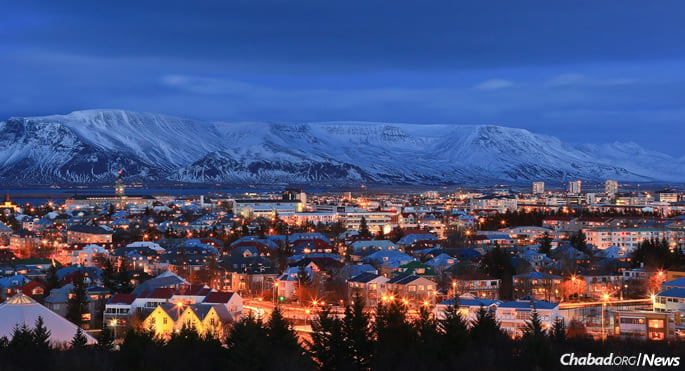
2. Jewish Warmth in Iceland

Iceland is a European island nation sitting just beneath the Arctic Circle. Jews have called it home for over a century, though for most of that time the community had no permanent rabbi or synagogue of its own. That changed in 2018, when Rabbi Avraham and Mushky Feldman moved to Reykjavik as Chabad-Lubavitch emissaries and opened Iceland’s very first Jewish center, bringing warmth and light to the Arctic ice.
3. The Closest Chabad House to the North Pole
In 1991, the Lubavitcher Rebbe sent Rabbi Yosef and Esty Greenberg to establish Chabad in Alaska, with the mission, in the Rebbe’s words, to “warm up Alaska.” But the Greenbergs, based in Anchorage, aren’t actually the northernmost Chabad emissaries in the world. That honor belongs to Rabbi Heshy and Chani Wolf in Fairbanks, where snow blankets the ground from October through April and temperatures can plunge to 40 degrees below zero Fahrenheit. Because of its far-north location, Fairbanks experiences 24 hours of sunlight at points in the summer, and less than four hours of daylight in the depths of winter!
Read: Northernmost Emissaries “Warm Up” Jewish Life on Alaskan Frontier
4. How Do You Do Night Mitzvahs When It’s Always Light?
For Jews living this far north, there are stretches of summer when it never gets dark enough to see the stars, the moment Jewish law considers nightfall. This creates some real halachic challenges when it comes to nighttime mitzvahs. For instance, while the evening prayer service can be recited early before nightfall, the evening Shema needs to be said after nightfall. Since true nightfall never comes, it is recited in the early a.m. hours instead, before sunrise. Similarly, Shabbat can be accepted early on Friday evening, but the Havdalah service marking its end has to wait until Sunday morning.
For Jews living within the Arctic Circle (see fact #6), the complexities increase, with questions like how to calculate the beginning and end of Shabbat when the sun doesn’t rise or set.1
5. Jewish Prospectors in the Yukon

The 1898 Klondike Gold Rush attracted tens of thousands of fortune seekers to the Yukon in Canada’s north, centered in Dawson City. Among them were about 200 Jews, some who came to look for gold, and others to offer their services to the prospectors. Most left when the gold rush died down, but some remained. In fact, there’s even a Jewish cemetery in Dawson City—although only one gravestone from 1918 remains intact.
This summer (2026), for the first time, Chabad Lubavitch sent a pair of Roving Rabbis to Whitehorse and Yellowknife, the capitals of Yukon and Northwest Territories respectively, where they found Jewish residents eager to learn more about their heritage.
6. Jews Within the Arctic Circle
As far north as the places above are, they’re all technically outside the Arctic Circle—the point where, at certain times of year, the sun stays above the horizon all night, and below it all day. The largest city actually within the Arctic Circle is Murmansk, Russia, home to over 250,000 people, including several hundred Jews. The community doesn’t have a synagogue or many of the other cornerstones of Jewish life, but local Jews do their best to keep Jewish tradition alive in this remote northern city.
7. Polar Regions in the Zohar
Remarkably, the Zohar, an ancient Kabbalistic text authored by Rabbi Shimon bar Yochai, gives an accurate description of the Earth’s revolution on its axis and how it affects the polar regions. Here’s a quote: “The world revolves in a circle like a ball. First one part is below, and then it is above …. Because of this, when it is light for some, it is dark for others. For some it is day, and for others it is night. There is also a place where it is always day, and it is only night for a very short time.”2
Read: What Is the Zohar?
8. Blessings on the Northern Lights

A special phenomenon often seen in northerly latitudes is the northern lights (or aurora borealis), shimmering green and purple hues caused by solar particles entering Earth’s magnetic field. When observing unique natural phenomena such as comets and shooting stars, the blessing of oseh maaseh bereishit (“... Who performs the work of creation”) is said.3 What about the northern lights? Some say the blessing should be said, but without G‑d’s name.
9. Jewish Explorers to the Poles
Many expeditions set out for the Arctic and Antarctic in the late 1800s and early 1900s, and quite a few included Jewish crew members. Edward Israel, a young Jewish man from Kalamazoo, Michigan, joined an ill-fated Arctic expedition in 1881, spending two years conducting scientific research there. Tragically, he died of starvation after the ship meant to resupply the crew never arrived.
On the opposite end of the globe, in 1928, a Jew named Bennie Roth served as a plane mechanic on an Antarctic expedition led by Richard Byrd. Though not observant himself, Bennie was proud of his Jewish identity, and he even brought along a prayer book, tzitzit, and a pair of tefillin to the frozen continent.
Read: At the Edge of Time: Practicing Judaism at Pittufik Space Base
10. Antarctic Tanyas
Believe it or not, the Tanya—the foundational work of Chabad philosophy, authored by the first Chabad Rebbe, Rabbi Schneur Zalman of Liadi—has actually been printed in Antarctica, not once but twice! In 1984, Rabbi Shabsi Alpern of Brazil arranged to have it printed at the continent’s Brazilian outpost. It was printed there a second time more recently by Chabad photographer Meir Alfasi.
11. The “Last Stop” to the South Pole
If Australia is “down under,” then the island of Tasmania, off its southeastern coast, is “down, down under!” As one of the closest landmasses to Antarctica, Tasmania is known as “the last stop to the South Pole,” often serving as the final point from which scientists and other travelers head onward to the icy continent. Tasmania is home to a small but active Jewish community with roots going back to the 1840s, and it’s had a Chabad presence since 2011.
12. Closest Jews to the South Pole
Even closer than Tasmania is the Patagonia region of South America. Its southernmost city, Ushuaia in Argentina, is the closest city in the world to Antarctica (under 700 miles away), and home to a small Jewish community of its own. They’re served by the Chabad emissaries in Bariloche, Argentina, some 1,300 miles to the north, which holds the distinction of being the closest Chabad House to the South Pole.
Read: On Top of the World at the Bottom of the World
All this just goes to show: no corner of the world is too remote for G‑d, the Torah, and Jewish life!


Start a Discussion