

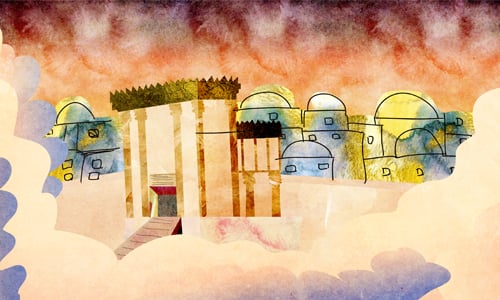
For over 800 years, the Holy Temple was the center of Jewish life. It was home to the Ark of the Covenant, the Menorah, the Altar, and other sacred items, and Jews would pilgrimage there three times a year. Although over 1,950 years have passed since its destruction, its memory remains very much alive in the hearts and minds of Jews worldwide. As we mark the Nine Days, let’s explore 11 ways Jews remember the Temple, its rituals, and its destruction throughout the year—until we merit seeing it rebuilt, may it happen today!
1. Sukkot: Holding the Four Species Each Day
In Temple times, the Four Species were held together only on the first day of Sukkot. The exception was in the Temple itself, where they were held all seven days. After the destruction of the Second Temple, Rabban Yochanan ben Zakkai instituted that Jews everywhere should hold the Four Species all seven days (except Shabbat), to remember the Temple.1
2. Sukkot: Circling the Bimah and Striking Willow Branches
In the Temple, the priests would circle the Altar each day of Sukkot holding the Four Species. Another ritual involved placing willow branches upright alongside the Altar. Today, we commemorate both these practices: each day of Sukkot (except Shabbat) after Hallel, we circle the bimah with the Four Species, and on the seventh day (Hoshana Rabbah), we hold five willow branches and strike them on the ground.2
3. Chanukah: Placing the Menorah in the South
On Chanukah, it’s customary to light a menorah in the synagogue, in addition to the one each person lights at home. It’s traditionally placed along the synagogue’s southern wall, recalling how the Temple’s Menorah stood on the south side of the sanctuary.3
4. Passover: Eating a Matzah and Maror Sandwich
At the Passover Seder, after eating matzah and maror (bitter herbs) separately, we sandwich some maror between two pieces of matzah and eat them together. Some say this commemorates Temple times, when the sage Hillel would combine the Paschal sacrifice, matzah, and bitter herbs and eat them together.4
Read: Why the Sandwich?
5. Passover: Eggs at the Seder
The Seder plate features an egg and a shankbone, recalling the two sacrifices eaten on that night in Temple times: the Paschal sacrifice and the chagigah (festive) sacrifice brought together with it.5
Some have the custom of eating that egg at the start of the Seder meal (Shulchan Orech). Why? The egg is a traditional symbol of mourning, and eating it reminds us of the Temple’s destruction. Even as we celebrate Passover, we remember that our celebration isn’t complete so long as we can’t bring the Paschal sacrifice as we once did.6
6. Breaking a Glass at a Wedding
A famous verse in Psalms declares: “Let my tongue cleave to my palate if I don’t remember you, if I don’t bring up Jerusalem above my greatest joy!”7 Even in our most joyous moments, we remember that no joy is complete without the Temple. That’s why the groom breaks a glass at the end of the wedding ceremony—to temper the celebration with a touch of sadness.8 In Ashkenazi communities, an earthenware jug (or porcelain plate) is also shattered at the engagement party, for the same reason.9
In the ancient Jewish community on the Tunisian island of Djerba, this custom had its own unique twist: the groom would climb to the roof and toss down two earthenware jugs!10
7. Placing Ashes on the Groom’s Forehead
Another mourning custom kept at weddings in certain communities is placing ashes on the groom’s forehead, right where the tefillin is worn.11 Interestingly, tefillin are referred to in Scripture as pe’er (פאר), meaning glory—a word that shares the same letters as efer (אפר), ashes.12 This hints at G‑d’s promise that, in the merit of placing ashes on this spot of glory, He will replace our ashes and mourning with the glory of the Redemption.13
Read: Why We Mourn
8. Serving Eggs to Newlyweds
In Moroccan communities, it’s customary to serve eggs to newlyweds at the wedding meal, as a sign of mourning over the Temple’s destruction.14
9. Leaving Part of a Home Unfinished
When building a home, it’s customary to leave a small patch opposite the front door unfinished, as a lasting reminder of every Jew’s true home, the Temple, which is yet to be rebuilt.15 In fact, there’s a tradition that homes which follow this practice are guaranteed to last long.16
Read: Moving to a New Home
10. Adding a Psalm Before Grace After Meals
The Zohar writes: “When enjoying food and drink at your table, remember and grieve the destruction of G‑d’s Temple. In this merit, it will be as if you rebuilt the Temple’s ruins.”17 In this spirit, on days when Tachanun is recited, it’s customary to say Psalm 137 before Grace After Meals: “On the riverbanks of Babylon, there we sat and cried when we recalled Zion …”18
11. Djerba: Trousers with a Black Sash
The traditional garb of Djerban Jewish men included loose, short trousers reaching to the knee, with a black sash tied around each knee—worn as a constant reminder of the Temple’s destruction.19
Read: 13 Facts About the Jews of Djerba
* * *
Whoever mourns Jerusalem will merit to see it in its state of joy (Taanit 30b).


Start a Discussion